
Summary: Cryptocurrency trading involves various fees that can impact both transactions and tax calculations. This blog explores the types of fees charged by exchanges, how these fees are reported (inclusive or exclusive), and their tax implications. It also explains how CRPTM can help manage these complexities, ensuring accurate tax reporting and compliance.
Introduction
Cryptocurrency trading has surged in popularity, bringing with it a complex landscape of fees that traders must navigate. These fees, charged by exchanges for various services, can significantly affect your trading costs and tax calculations. Whether you’re a seasoned investor or new to the world of crypto, understanding these fees, how they’re structured and reported, is essential for optimizing your trading strategy and ensuring accurate tax reporting. This blog will break down the different types of fees, explain their implications, and show how CRPTM can help you manage these intricacies with ease.
Key Takeaways
- Understand different cryptocurrency exchange fees and their impact on transactions.
- Know the difference between inclusive and exclusive fees for accurate tax reporting.
- Proper fee adjustment is crucial for calculating capital gains or losses correctly.
- Accurate record-keeping of all fees is essential for compliance in tax reporting.
Types of Cryptocurrency Exchange Fees
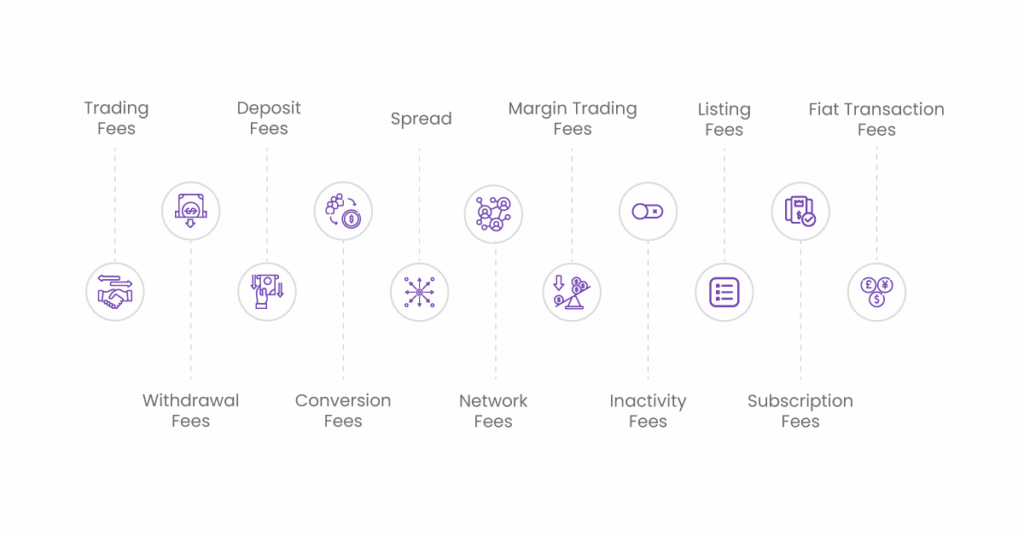
Cryptocurrency exchanges use various fee structures to generate revenue and cover operational costs. Here are the common types of fees you might encounter:
1. Trading Fees
- Maker Fees: Charged to users who create new orders that add liquidity to the market. Pricing is usually a small percentage of the transaction, like 0.1%-0.2%. When you create a new order that doesn’t match any existing order immediately, you are adding liquidity to the market. This means you are contributing to the pool of available buy or sell orders, making it easier for other traders to execute their trades.
- Taker Fees: Charged to users who take existing orders off the market. Taker fees can go up to 0.5% or higher, depending on the exchange and trading volume. When you place an order that immediately matches with an existing order on the order book, you are taking liquidity. This means you are removing an order from the pool of available buy or sell orders.
- Percentage-Based Fees: These are fees calculated as a percentage of the total value of each trade you make. The percentage can vary based on your trading volume; higher trading volumes might get lower fees. For example, if you trade $1,000 worth of Bitcoin and the fee is 0.1%, you would pay $1 in fees. Fees typically range from 0.1% to 0.5% of the trade value.
2. Withdrawal Fees
Fixed fees charged when you transfer cryptocurrencies out of the exchange to an external wallet. For example, Bitcoin withdrawals might cost around 0.0005 BTC.
3. Deposit Fees
Fees for depositing funds into the exchange, typically applied to fiat currencies. For instance, a bank transfer might cost $10-$25.
4. Conversion Fees
Fees for swapping one cryptocurrency for another within the exchange. This is usually a small percentage of the transaction amount, around 0.1%-0.5%.
5. Spread
The difference between the buy and sell prices. For example, if Bitcoin’s buy price is $50,000 and the sell price is $49,500, the $500 difference is the spread.
6. Network Fees
Fees paid to the blockchain network for processing transactions. These vary by cryptocurrency; for example, Ethereum transactions might cost around $1-$5.
7. Margin Trading Fees
Fees for borrowing funds to trade on margin, including interest. Interest rates can be around 0.01%-0.1% per day.
8. Inactivity Fees
Charged if your account is inactive for a certain period, typically a few dollars per month after several months of inactivity.
9. Listing Fees
Fees paid by cryptocurrency projects to get their tokens listed on the exchange. These can range from a few thousand to hundreds of thousands of dollars.
10. Subscription Fees
Fees for premium services or accounts, such as advanced trading tools, costing anywhere from $10 to $50 per month.
11. Fiat Transaction Fees
Fees for processing fiat currency transactions, such as credit card deposits. These can range from 1%-4% of the transaction amount.
Inclusive vs. Exclusive Fees
Inclusive Fees | Exclusive Fees |
| When fees are adjusted in the transaction value, the cost basis for tax purposes automatically get calculated. For example: | When fees are reported separately, you must manually adjust your cost basis. For example: |
| Buying: If you buy 1 BTC for $10,000 and the fee is adjusted (total cost $10,100), your cost basis is $10,100. | Buying: If you buy 1 BTC for $10,000 and pay a $100 fee separately, your cost basis is $10,100. |
| Selling: If you sell 1 BTC for $10,000 and the fee is adjusted, your selling price will be $10,000 but for tax purposes, you report $ 9,900 as sell proceeds. | Selling: If you sell 1 BTC for $10,000 and pay a $100 fee separately, your selling price is $10,000, but you receive $9,900 after fees as sell proceeds. |
| Trading: If you trade 1 BTC for 20 ETH, and the fee of $100 is included, the value of the BTC you traded is $10,000, but you might receive ETH worth $9,900 after fees. For tax purposes, sell proceeds is still reported as $10,000 for 1 BTC and cost basis will be reported as $10,000 for 20 ETH. | Trading: If you trade 1 BTC for 20 ETH, with a separate $100 fee, the value of the ETH you receive is $10,000, but you must add the $100 fee to your cost basis, making it $10,100. You sold BTC worth $10,000. For tax purposes, the trade value and cost basis need careful adjustment. For tax purposes, sell proceeds is still reported as $10,000 for 1 BTC and cost basis will be reported as $10,100 for 20 ETH. |
Tax Implications of Cryptocurrency Fees
Understanding how fees are reported can significantly impact your tax calculations:
1. Cost Basis Calculation
- Inclusive Fees: Automatically adjusted, simplifying tax reporting.
- Exclusive Fees: Requires manual adjustment to include fees in the cost basis.
2. Fees Adjustment
- Whether fees are inclusive or exclusive, it’s crucial to accurately adjust the reported amounts for both buying and selling transactions. We are automatically adjust the cost basis or proceeds whether fee is inclusive or exclusive when calculating capital gains or losses.
3. Capital Gains and Losses
- Fees impact the calculation of capital gains or losses. Properly accounting for these fees ensures accurate tax reporting.
4. Tax Reporting
- Detailed record-keeping is essential, whether fees are inclusive or exclusive. Ensure all fees are accounted for in your tax reports.
Factors Influencing Exchange Fees
- Trading Volume: The amount of cryptocurrency you trade on an exchange over a certain period influences your fees. Higher trading volumes often qualify for lower fee rates as a reward for being an active trader. For example, if you trade a large amount of Bitcoin each month, you might pay lower fees compared to someone who trades only a small amount.
- Type of Order: The type of order you place—maker or taker—affects the fees you pay. Maker orders add liquidity to the market by placing new orders that are not immediately filled, usually resulting in lower fees. Taker orders remove liquidity by filling existing orders, which typically come with higher fees.
- Payment Method: The way you deposit or withdraw funds can impact the fees. Using a credit card to buy cryptocurrency usually incurs higher fees due to processing costs, while bank transfers might be cheaper. Depositing and withdrawing cryptocurrencies often have different fee structures too.
- Cryptocurrency Type: Fees can vary depending on the cryptocurrency you are dealing with. For example, withdrawing Bitcoin might be more expensive than withdrawing other cryptocurrencies due to higher network transaction fees. Each cryptocurrency has its own fee structure based on network demand and other factors.
- Exchange Membership Level: Some exchanges offer tiered membership levels or VIP programs. Higher membership levels often come with lower fees and additional benefits. For example, if you are a VIP member, you might enjoy reduced trading fees and faster customer support.
- Geographic Location: Where you live can influence the fees you pay. Different countries have different regulatory environments and banking relationships, which can affect the cost of transactions. For instance, users in some countries might face higher fees due to stricter regulations or fewer banking options.
- Promotional Offers: Exchanges sometimes offer temporary discounts or fee reductions. These promotions can significantly lower your trading costs for a limited time. For example, an exchange might reduce fees during a special event or to attract new users.
- Regulatory Compliance: Compliance with local and international regulations can impact fees. Exchanges incur costs to meet regulatory requirements, and these costs can be passed on to users through higher fees. Staying compliant ensures the exchange operates legally but might increase the overall fees.
What Happens if You Don’t Consider Fees Correctly?
Exclusive Fees Not Considered: If you fail to include the exclusive fee in your cost basis, you may end up underreporting your cost basis and overreporting your capital gains. This can result in paying more taxes than necessary. For example:
- Ignoring Exclusive Fee: If you buy 1 BTC for $10,000 and ignore the $100 fee, your cost basis is incorrectly reported as $10,000. If you sell for $15,000, your capital gain is incorrectly calculated as $5,000 instead of $4,900.
Inclusive Fees Considered Again: If you mistakenly add the inclusive fee again, you may end up overreporting your cost basis and underreporting your capital gains. This can lead to underpaying taxes, which could trigger penalties or audits. For example:
- Double-Counting Inclusive Fee: If you buy 1 BTC for $10,000 with the fee included (total $10,100) and then mistakenly add another $100 fee, your cost basis is incorrectly reported as $10,200. If you sell for $15,000, your capital gain is incorrectly calculated as $4,800 instead of $4,900.
How can CRPTM Help?
Navigating the complexities of cryptocurrency exchange fees and their tax implications requires careful attention to detail. This is where CRPTM can provide invaluable assistance:
 Automated Fee Tracking
CRPTM’s platform automatically tracks and records all transaction fees, ensuring they are accurately included in your cost basis and capital gains calculations.
 Accurate Tax Reporting
CRPTM generates detailed tax reports that account for all fees, whether inclusive or exclusive, minimizing the risk of errors and ensuring compliance with tax regulations.
 Comprehensive Transaction Analysis
CRPTM offers tools to analyze your transactions comprehensively, helping you understand the impact of fees on your overall profitability and tax liability
 User-Friendly Interface
CRPTM’s intuitive interface simplifies the process of managing and reporting cryptocurrency taxes, making it accessible even for users with limited tax knowledge.
 Expert Support
CRPTM provides access to tax professionals who can offer personalized advice and support, helping you navigate complex tax situations and optimize your tax strategy.
 Integration with Exchanges
CRPTM’s intuitive interface simplifies the process of managing and reporting cryptocurrency taxes, making it accessible even for users with limited tax knowledge.
 Flexibility for Inclusive and Exclusive Fees
CRPTM allows users to specify whether fees are inclusive or exclusive of the transaction value, offering flexibility to match the reporting methods of different exchanges. This feature ensures that your cost basis and capital gains calculations are accurate and tailored to your specific trading activities.
Conclusion
Understanding cryptocurrency exchange fees is essential for optimizing your trading and ensuring accurate tax reporting. The way fees are structured, whether inclusive or exclusive, can directly impact your cost basis and capital gains calculations. Properly accounting for these fees and maintaining detailed records is vital for minimizing tax liabilities and maximizing profitability. By being proactive in managing these fees, you can make informed decisions that enhance your overall success in the cryptocurrency market.
Disclaimer: The information presented on this website is intended for general informational purposes only and should not be interpreted as professional advice from CRPTM. CRPTM does not offer financial advice. We strongly recommend seeking independent legal, financial, tax, or other professional advice to determine how the information provided on this website applies to your specific circumstances. CRPTM assumes no liability for any loss incurred, whether due to negligence or otherwise, resulting from the use of or reliance on the information contained herein.